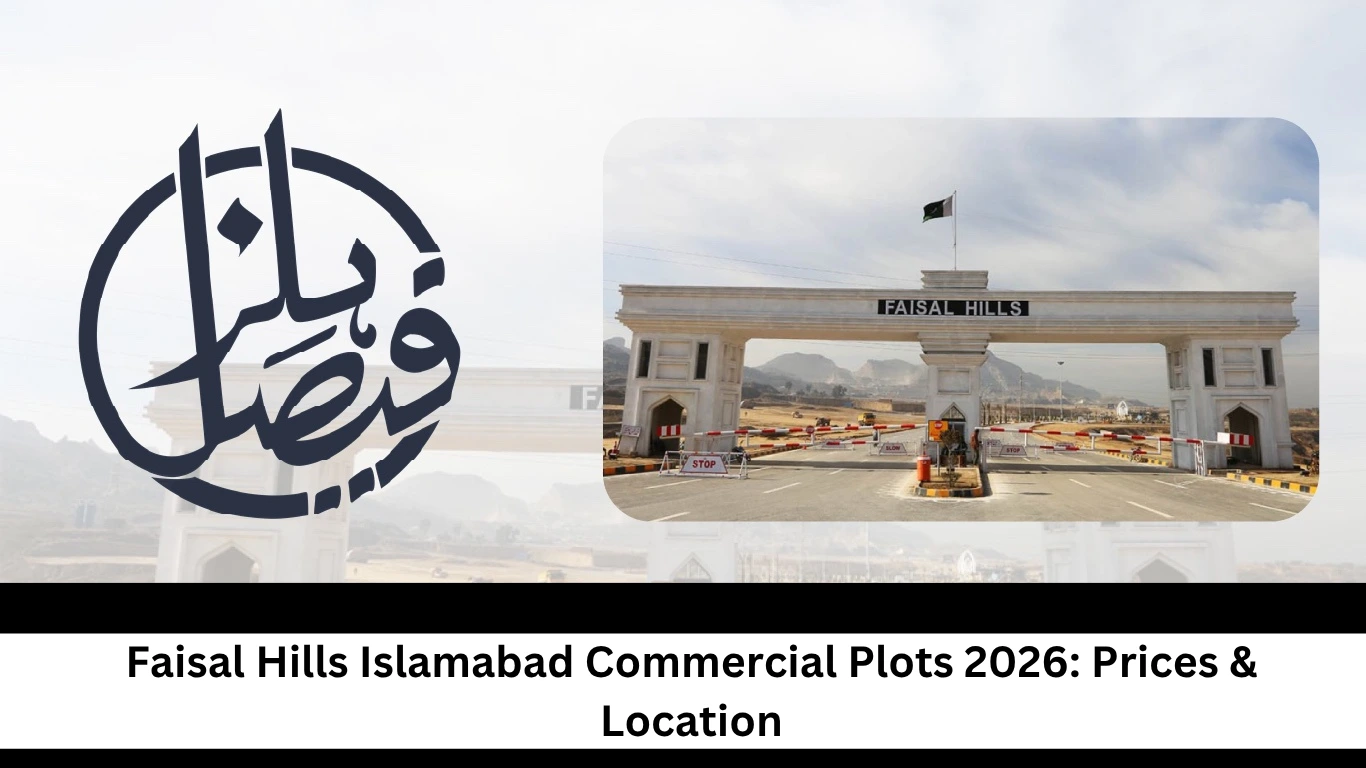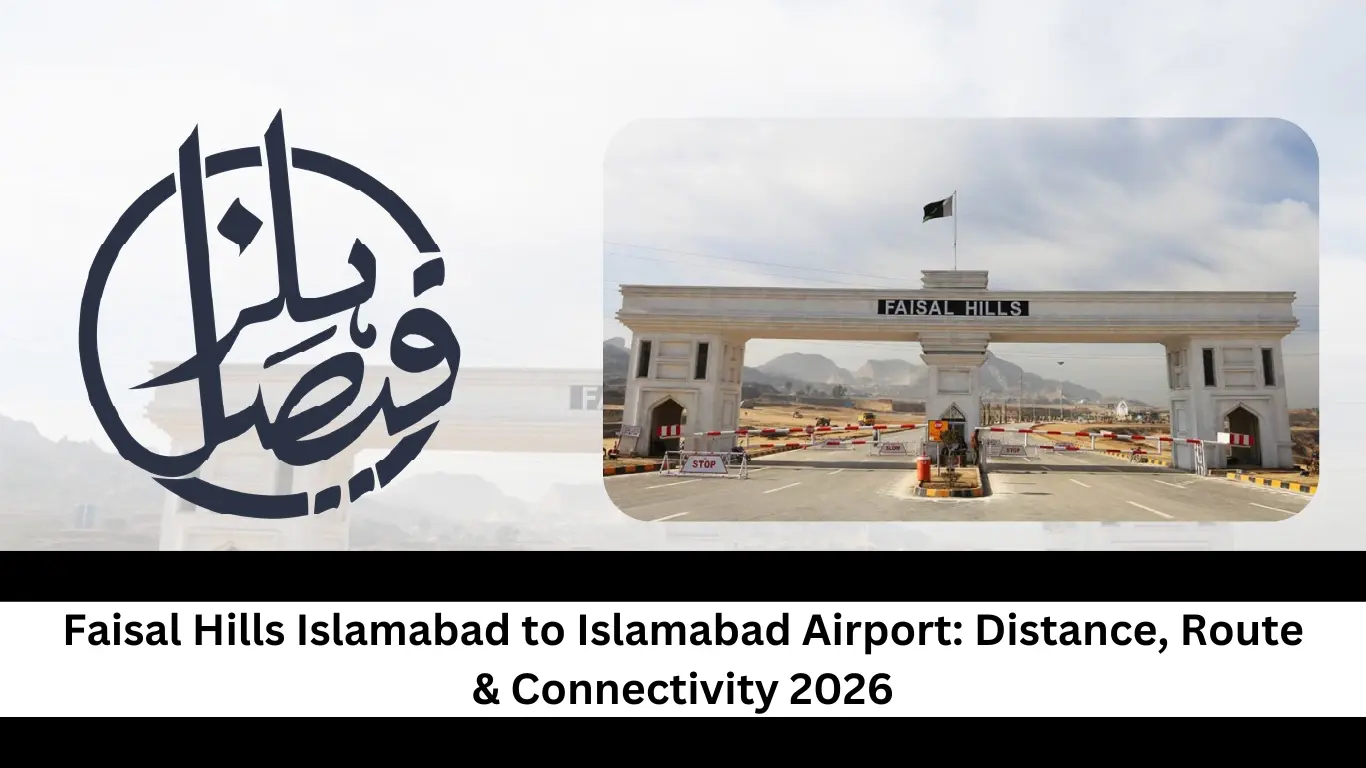
Everyone comparing Faisal Hills to closer societies eventually asks the same thing. How far is it from the airport, actually? Faisal Hills Connectivity matters here, especially for buyers who travel frequently. Not the number a sales page throws at you, the real one, the drive you make half-asleep at five in the morning because your flight’s at eight. Faisal Hills Islamabad sits further out than most of what people compare it to, out along the GT Road toward Taxila, and that extra distance is usually the first thing that gives buyers pause.
So the article actually has to do with the actual airport distance, the route people have to take to get there, the roads that make that route possible, and a few items to check out before assuming the trip is shorter or longer than the number that you saw first. We’ll also get into what Faisal Hills Connectivity actually means once the listing-page language gets stripped away.
Faisal Hills Islamabad and Islamabad Airport: How Are They Connected?
Faisal Hills sits on the Main GT Road, N-5, just outside Taxila. B-17 is close, a few minutes at most. Islamabad Airport sits on the opposite end of the city’s growth corridor, nearer the M-1 and M-2 network. Look at a map and the two seem within reach of each other. Drive it, and you realise how much of that closeness is just how maps flatten distance.
Two routes get mentioned constantly.
One route goes through Margalla Avenue. It connects with GT Road near B-17 and leads toward Islamabad’s Zone 1 sectors. The other keeps to the GT Road, running through Sangjani and Tarnol before it picks up the motorway. There isn’t a correct answer between the two.
It depends on where you’re starting in Faisal Hills and how the traffic looks that morning.It depends on where you’re starting in Faisal Hills and how the traffic looks that morning. This makes Faisal Hills Connectivity an important factor for buyers who travel regularly.
Faisal Hills Islamabad to Islamabad Airport Distance
Look up the Airport Distance for Faisal Hills on five different websites and you’ll probably get five different numbers. Fifteen minutes on one page. Twenty-two on another. A couple of the more careful ones put it closer to forty, with a road distance past thirty-five kilometres. Technically none of them are lying.
Part of the problem is straight-line distance versus road distance. A map draws a shortcut between two dots. The road doesn’t care about that shortcut, it bends around hills, cuts through junctions, and stops at toll plazas. The other part of the problem is that Faisal Hills isn’t one address, it’s a whole society spread across Blocks A, B, C, D, the Executive Block, and the Prime Block. A plot right off the main gate on GT Road is simply closer to Islamabad than one sitting deep inside the society. Throw in rush hour, and the number moves again. A foggy December morning can change it too. Take any single figure you find with a grain of salt.Nobody can hand you an exact minute count that holds up every day of the week.
Best Airport Route from Faisal Hills
From the main entrance on the GT Road, most people end up choosing between two ways in.
The first, and the one locals mention more, runs along the GT Road toward Sangjani and Tarnol, past the Sangjani Toll Plaza, then onto the M-1 Motorway near the AWT interchange. From there it’s motorway the whole way until the exit onto Islamabad Airport Road for the last stretch. It’s longer in kilometres. It’s also usually faster, because motorway traffic behaves itself in a way city roads never do.
Alternative Airport Route via Margalla Avenue
The second route cuts through Margalla Avenue and meets GT Road near B-17. It then leads toward Islamabad’s western side before reaching the airport corridor. Shorter on paper. Slower in practice, more often than not, once you factor in signals and local traffic through those sectors. A few older listings still bring up Srinagar Highway as a third path. People report that it usually adds distance rather than saving time, so it is no longer a serious contender.
Main Roads Connecting Faisal Hills with the Airport
The M-1 Motorway carries the bulk of this trip, and it’s the fastest stretch by a fair margin once you’re actually on it. GT Road does something completely different, it gets you out of Faisal Hills toward B-17, Sangjani, or the motorway entrance, but it was never a direct line to the airport and never will be. Islamabad Airport Road is the last piece, the road that turns a motorway drive into an arrival. Margalla Avenue fits in mostly for people who are already closer to western Islamabad than to Faisal Hills itself.
Alternative Airport Route via Margalla Avenue
The second route cuts through Margalla Avenue, meeting the GT Road near B-17 and pushing more directly into Islamabad’s western side before eventually reaching the airport corridor from there. Shorter on paper. Slower in practice, more often than not, once you factor in signals and local traffic through those sectors. A few older listings still bring up Srinagar Highway as a third path. Going by what people actually report driving it, that one tends to add distance rather than save it, so it’s not really a contender anymore.
Main Roads Connecting Faisal Hills with the Airport
The M-1 Motorway carries the bulk of this trip, and it’s the fastest stretch by a fair margin once you’re actually on it. GT Road does something completely different, it gets you out of Faisal Hills toward B-17, Sangjani, or the motorway entrance, but it was never a direct line to the airport and never will be. Islamabad Airport Road is the last piece, the road that turns a motorway drive into an arrival. Margalla Avenue fits in mostly for people who are already closer to western Islamabad than to Faisal Hills itself.
Faisal Hills Connectivity and Major Road Links
There’s no single road doing all the work for Faisal Hills Connectivity. GT Road covers the local trips, the M-1 sits close enough for anything longer, and B-17 is near enough for school runs and grocery runs alike. Add it up and the society gets a decent link into Islamabad and Rawalpindi, even without a motorway running past its own front gate.
M-1 Motorway Access
The motorway isn’t just an airport shortcut. It also carries traffic toward central Islamabad and Rawalpindi, and it opens the door to longer trips for anyone travelling beyond the twin cities on a regular basis. If you’re on the road several times a week, this is the piece of infrastructure that ends up mattering, far more than whatever single number a brochure printed.
GT Road and Local Access
GT Road plays a smaller, more local part. It ties Faisal Hills to Taxila, to B-17, to the smaller neighbourhoods strung along that stretch. It was never meant as an airport road, so treating it like one just sets up disappointment. Most residents use it to get somewhere else entirely, usually the motorway or B-17, not as a route to the terminal by itself.
Is Faisal Hills Convenient for Frequent Airport Travellers?
For someone flying often, kilometres barely enter the conversation. What matters is whether the drive feels predictable at odd hours, and how much buffer you have to build in before a red-eye lands. Whether that trade is worth it comes down to how often that airport run actually happens, and which block someone picks in the first place. For frequent travellers, Faisal Hills Connectivity can make this decision easier to evaluate.
Overseas Pakistanis flying home once or twice a year, business travellers with early flights, that crowd tends to find Faisal Hills workable, mainly because of the motorway access and the closeness to B-17. It’s not the nearest society to the airport. Nobody’s claiming that. But once you know the route, the drive settles into something manageable rather than a headache. Families weighing this against a shorter commute somewhere central often end up trading a bit of drive time for space and quiet. Whether that trade is worth it comes down to how often that airport run actually happens, and which block someone picks in the first place.
Faisal Hills Location: What Buyers Should Know
Faisal Hills Location follows the GT Road corridor, close to Taxila, B-17 only a short drive off. That puts it near several sectors that are already built out, while still keeping room to breathe compared to anything closer to central Islamabad. Schools, small markets, and a handful of hospitals sit within reach along the same stretch, which matters for anyone thinking beyond just the airport question.
The master plan puts Blocks A, B, C, D, and the Prime Block at different distances from the main GT Road gate. Two plots technically inside the same project can mean two very different daily drives. Add Taxila’s own growth and whatever construction happens to be going on that season, and the picture shifts further. None of this replaces checking the actual location details. It is important to remember that “Faisal Hills” does not mean the same drive time for every buyer.
What Can Affect Travel Time to Islamabad Airport?
A handful of things move the number around more than most listings ever admit. Peak-hour traffic near the GT Road junctions and the motorway entrances is the obvious one, anyone who’s crawled through Tarnol at six in the evening already knows. Construction on the M-1 corridor or in the vicinity of Sangjani comes and goes with little warning and can add 15 minutes to an otherwise uneventful time.
This is a very foggy area in the winters, and it can occur for days on end, and slow all activity down between Islamabad and Rawalpindi. The route itself changes the rhythm too, GT Road, Margalla Avenue, and the motorway each move differently depending on the hour. Starting block plays its part as well, the Prime Block isn’t the same drive as somewhere deep in Block D. And once you’re actually at the airport, security and general terminal traffic add their own buffer on top. Put it all together and a single best-case travel time rarely survives an actual trip.
Faisal Hills Airport Connectivity: Is It Good for Buyers?
M-1 access, the closeness to B-17, and a route to the airport that actually works, together these give Faisal Hills Connectivity real weight, especially for anyone planning to rent out to professionals or frequent flyers down the line. Set against that: travel time changes by block, road development around Sangjani keeps shifting, and none of the distance figures floating around online should be treated as gospel. Before booking anything, it’s worth checking Faisal Hills verification or a current investment overview instead of trusting whatever number shows up first in a search. Airport access should sit alongside NOC status, development progress, and actual demand, not stand in as the only reason to sign.
Final Verdict
So does the airport distance make or break Faisal Hills as a choice? Not really, and it shouldn’t. The drive isn’t the shortest in Islamabad, and nobody serious about this project should pretend it is. So does the airport distance make or break Faisal Hills as a choice? Not really, and it shouldn’t. The drive isn’t the shortest in Islamabad, and nobody serious about this project should pretend it is. It offers a workable, motorway-backed route that becomes easier with familiarity. It also provides access to the M-1 and a short connection to B-17 for everyday needs.
For someone flying two or three times a year, this distance is a non-issue within a few trips. For someone catching flights weekly, it’s worth an honest conversation with yourself about how much that extra twenty minutes actually costs you, against what Faisal Hills offers in space, price, and long-term potential. In either case, the better the decision is made based on what is on the actual road, as opposed to the number that comes up first in a search. Those who are still considering this can directly contact us for the updated access information prior to booking.
Frequently Asked Questions
Q1: How far is Faisal Hills Islamabad from Islamabad Airport?
Ans: Depends who you ask. Some sources suggest fifteen minutes, while others suggest forty. The actual time depends on the route and the block. Road distance matters more than straight-line distance. Therefore, check current road conditions before relying on any single figure.
Q2: What is the best airport route from Faisal Hills?
Ans: Most people take GT Road toward Sangjani and join the M-1 Motorway. They then use Islamabad Airport Road for the final stretch. Margalla Avenue is another option for those starting closer to B-17 or western Islamabad. However, traffic conditions can affect both routes.
Q3: Is Faisal Hills well connected to Islamabad Airport?
Ans: Faisal Hills has reasonable airport access through the M-1 and GT Road. However, it does not offer the same direct road connection as some societies closer to the airport. Judge it on the actual drive rather than assuming a short commute every time.
Q4: Does the M-1 Motorway improve Faisal Hills airport access?
Ans: Yes, and it’s probably the single biggest factor in the whole equation. Once you reach it from GT Road, it forms the core of the airport route. It also serves as a major intercity road toward Rawalpindi and Islamabad.
Q5: Is Faisal Hills near B-17 Islamabad?
Ans: Yes, a few minutes away along the GT Road. That closeness helps with everyday errands and adds to the overall picture of Faisal Hills Location sitting near an established Islamabad sector.
Q6: Why is airport access important for Faisal Hills buyers?
Ans: It can shape daily life for frequent travellers. It may also influence rental demand among professionals and overseas Pakistanis who value this convenience. However, buyers should consider it alongside development status, NOC approval, and the master plan. It should not be the only factor behind a buying decision.