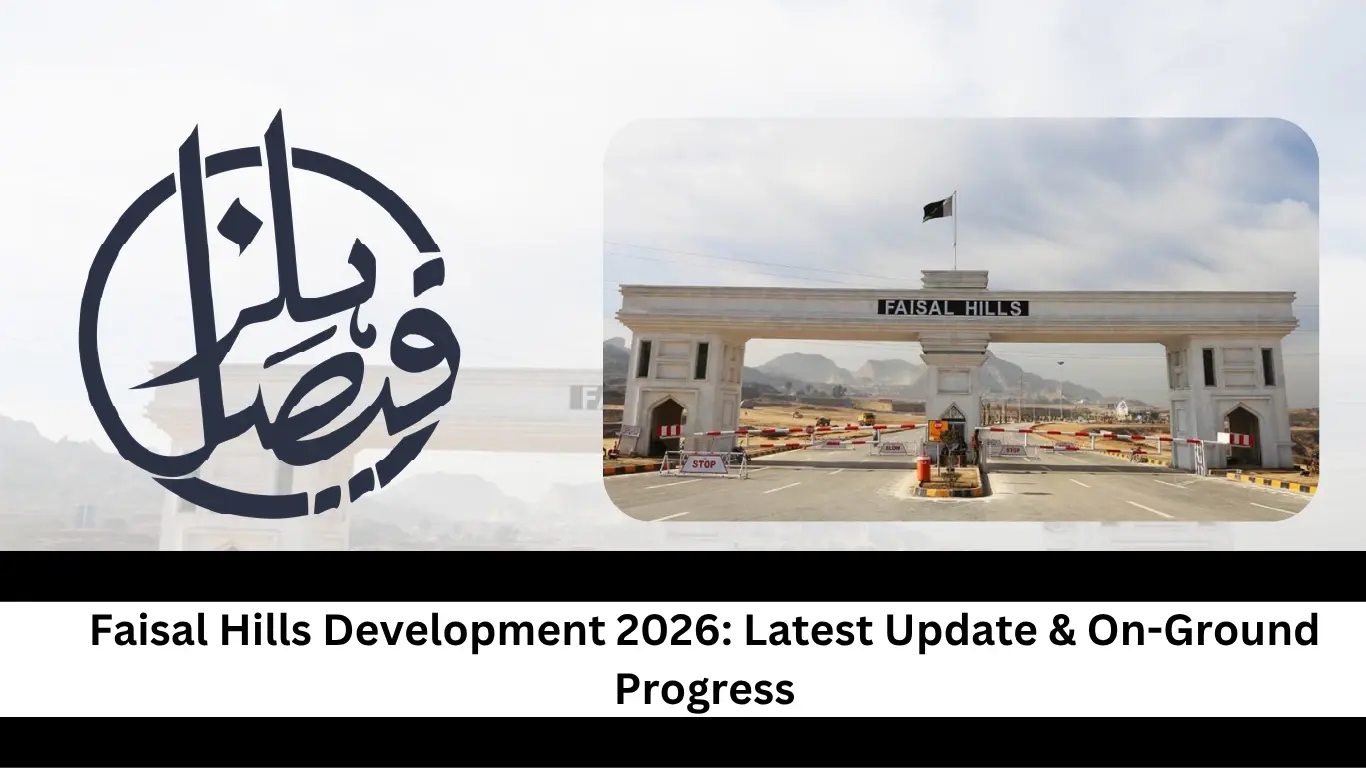
If you have been following Faisal Hills Progress in 2026, you have probably seen plenty of development updates, but the real question is what has actually changed on the ground. Roads, construction, utilities, and block-wise development can tell a much clearer story than repeated marketing claims. In this update, we look at the latest visible progress and what buyers should verify before making a decision.
Faisal Hills Islamabad isn’t unusual in this regard. The master plan looks clean, blocks are drawn neatly, roads line up the way they’re supposed to on paper. But once you’re actually walking around, the picture gets messier, in a good way and a bad way at the same time. One block feels well ahead of schedule. Another feels like it’s been sitting for a while. That’s just how big projects grow, in patches, not in one smooth wave, and pretending otherwise helps nobody.
So rather than repeating the usual “Faisal Hills is thriving” line you’ll find everywhere, this piece sticks to what’s actually checkable right now, in 2026. Roads, both the big ones and the small ones. What’s being built and where. Whether basics like power and water actually reach the ground. Read through this and you’ll know exactly what to look for when you go see it yourself, instead of nodding along to whatever a broker tells you over the phone.
Faisal Hills Progress: Development Status in 2026
Before comparing blocks against each other, it helps to step back first. When people say “Faisal Hills Progress,” they’re usually lumping together a handful of separate things: road condition, plot preparation, how much construction is actually happening, whether utilities work, occupancy, and commercial activity. Each of these answers a different question, and honestly, treating them as one blurry idea is where most articles go wrong.
Here’s a point that gets skipped constantly. A project being developed and a specific plot being ready are not the same thing at all. You can have a beautifully finished main road while a plot sitting two streets deep has zero real access and no working connection. People drive through a nice gate, assume the rest matches, and that assumption is honestly the root of most complaints you’ll hear later from buyers.
For a general layout reference, the Faisal Hills Master Plan works fine. Just don’t confuse it with proof that construction has caught up to the drawing. Those are two very different things, even if they share a name.
What Has Actually Improved on the Ground?
Main Roads and Access
Main roads tend to be the first visible sign that a project is actually moving forward. In Faisal Hills, the primary routes connecting the major blocks have clearly improved. Driving in feels a lot more organized than it used to a couple of years back, and reaching the interior sections from the main road network has gotten noticeably easier in several places too.
That doesn’t mean everything past the gate is equally polished, though, not even close. Some stretches have good surfacing with clear lane markings. Others still need a proper look before anyone calls them finished. My advice? Skip the map for this one. Drive from the main entrance straight to your plot. That short drive tells you more than a satellite image ever will.
Internal Roads
Nobody talks much about internal roads, but they’re the ones that actually matter once you’re living somewhere. A grand boulevard looks great in a brochure photo. A rough internal street is what you’ll actually drive over every day if you move in. Internal road quality in Faisal Hills shifts quite a bit depending on exactly where you’re standing.
It’s totally normal for a society to have an impressive entrance while several internal streets are still catching up behind it. Phased development just works this way, and Faisal Hills isn’t an exception. If you’re planning to build soon, go check the street right outside your specific plot. Don’t assume the rest of the layout matches the entrance, because it probably doesn’t.
Plot Development and Construction Work
Real construction tells you more than any announcement ever could. Press releases are cheap. Boundary walls, half-built houses, and completed homes sitting next to each other, that’s real. And you do see that combination in parts of Faisal Hills, which suggests actual people are actually building, not just sitting on paper files hoping for appreciation.
It’s uneven, though, no way around that. Some sections have crews out there most weeks. Others are quiet, with far fewer structures and much less visible movement. If someone hands you an exact completion percentage, they’re guessing, because there’s genuinely no reliable way to verify a number like that. What’s fair to say is that construction activity clearly depends on which part of the project you’re standing in at the time.
Faisal Hills A Block Development Status
Faisal Hills A Block gets mentioned a lot, partly because of where it sits within the overall layout. On the ground, road development here is fairly solid, and getting into the block on a regular day isn’t much of a hassle.
Construction is mixed, the way most active blocks tend to be right now. Finished houses sit next to plots that are still empty or barely prepped. That’s normal for this stage, not something to worry about. Utility infrastructure appears present in a good number of spots, but that’s a starting point, not a guarantee for your own plot. Go confirm it yourself, don’t take someone’s word for it.
If you’re considering a plot here, use the road network as a first impression only. Walk or drive to the actual plot rather than judging from the block entrance. Takes maybe ten minutes and can save you a lot of grief down the line.
Faisal Hills B Block Development Status
Faisal Hills B Block tells a pretty similar story to A Block, though it’s not a carbon copy. Road access into the block works fine, and a fair number of internal streets have gotten some attention as well.
Plot development swings both ways here too. Some sections have active construction happening as we speak, while others are still sitting undeveloped. Nothing unusual for a block that’s still growing into itself. And yes, same rule again, utility availability needs a plot-by-plot check, not a general assumption based on the block as a whole.
Compared with A Block, B Block isn’t dramatically ahead or behind. Both are moving, just not at the same pace on every single street.
Faisal Hills Executive Block Development Status
The Faisal Hills Executive Block gets more buzz than the rest of the project, and to be fair, some of it is earned. On site, roads look more established here, construction is easier to spot, and there are clearer signs of people actually living there compared to several other sections.
That said, calling it “fully developed” would be overselling it. A few pockets are still under active work, and while commercial activity does exist, it hasn’t reached the level of a genuinely mature commercial zone yet. A more accurate way to put it: Executive Block looks more mature and more built out than most other blocks, without every plot inside it being finished or occupied. Small difference in wording, big difference in what it actually means for you.
If Executive Block is where you’re planning to buy, don’t skip the individual checks just because the block looks impressive from the road. Confirm construction status and utilities for your exact plot anyway.
Utilities: Electricity and Water Supply
This part matters more than almost anything else in this article, honestly. A buyer can live with a half-finished street or missing landscaping. Almost nobody adjusts well to electricity or water that just doesn’t show up.
Electricity Availability
Electricity infrastructure, poles, lines, all the visible parts, exists across large parts of Faisal Hills, and residents in the more developed areas seem to be using it without trouble. Here’s the catch though. Infrastructure existing somewhere in the block doesn’t automatically mean your plot has an active connection. That status genuinely varies from plot to plot, especially in the newer sections.
If you’re building soon, confirm your exact connection status with the relevant department directly. Don’t assume it just because your future neighbor’s house already has power.
Water Supply
Water infrastructure shows up in the more developed parts of the project, and supply looks fairly regular in areas with higher occupancy. In newer or less-developed sections, though, don’t take that for granted at all. Some residents there are still relying on backup arrangements while the main system catches up.
Same logic as electricity applies here. What’s planned at the project level and what actually reaches your plot are two different questions. Mixing them up is exactly how people end up frustrated after they’ve already moved in and paid for everything.
Other Utility Considerations
Sewerage and street lighting look more developed in mature sections and noticeably less so in newer ones. Drainage is worth checking in person, especially for plots sitting in lower areas. And if there’s simply no solid evidence for a particular utility, the honest move is to flag it as “confirm this yourself” rather than assume it’s fine and move on.
Which Parts of Faisal Hills Show More Development?
No project this large grows evenly, and Faisal Hills is no exception. Some pockets have stronger roads, more construction, and better utility visibility. Others are still early, with fewer finished structures and patchier street development.
Instead of ranking blocks top to bottom, it makes more sense to think in loose categories. Certain areas are clearly more mature, with established roads and visible occupancy. Others fall somewhere in the middle, showing genuine progress but still needing confirmation on utilities and access. A smaller slice is still very much a work in progress, with crews actively doing groundwork.
This kind of grouping is honestly more useful than a “top 3 blocks” list, especially since conditions on the ground can shift within a few months anyway.
Ground Development vs Project Map
This is probably the single most important idea in this whole article. A map tells you where a block starts, how roads are supposed to line up, and roughly where your plot sits. That’s it, really. It says nothing about whether that road is actually paved, whether anyone’s building nearby, or whether utilities actually work when you flip the switch.
The ground fills in everything the map can’t. Real road surfacing. Real construction, or the lack of it. Working connections, or connections that don’t work yet. Actual activity happening around your specific plot. A map can point you to where your land technically is. It can’t tell you what that spot looks like today.
Which is why a site visit will always beat a screenshot, no matter how good the map design happens to be.
What Is Still Pending?
A report that only talks about finished work isn’t much of a report, so let’s cover what’s still missing. Some internal roads, particularly the ones further from the main entrance, remain incomplete. Construction activity is lower in certain sections, which naturally slows down everything else nearby, utilities included.
Utility connections in newer areas often need direct confirmation rather than assumption. Occupancy is still limited in some blocks, which makes them feel a lot emptier during a visit than the master plan would ever suggest. Commercial zones are progressing, sure, but they haven’t caught up to what the early marketing promised. None of this means the project has stalled. It just means development is still ongoing, and buyers should treat it that way instead of expecting a finished product.
What Does Faisal Hills Progress Mean for Investors?
Generally speaking, Faisal Hills Progress helps build buyer confidence when roads, construction, and utilities are visibly improving. Roads, ongoing construction, utilities that work, all of it makes a plot easier to trust today and easier to sell later. So current progress in Faisal Hills is a reasonably positive signal if you’re evaluating it from an investment angle.
But progress alone doesn’t guarantee returns, and it never has. Price appreciation depends on a bunch of other factors too. Where exactly your plot sits within the block. Whether the paperwork is clean. What the broader market looks like at the time. How much demand actually exists whenever you decide to sell. Faster development in one section won’t automatically speed up resale somewhere else in the same project.
Before letting development alone talk you into buying, it’s worth reading through Faisal Hills Investment 2026 considerations too. Infrastructure and investment potential are related, sure, but they’re not the same conversation. Purchase price, access, plot location, and how long you plan to hold all matter just as much as how developed the area looks today.
Is Faisal Hills Becoming More Suitable for End Users?
This is a different question from investment potential, even though people mix the two up all the time. If you’re planning to actually live there instead of flipping it later, practical stuff starts mattering more than long-term price growth. Road access, working electricity and water, occupied houses nearby, basic daily conveniences. This is what you’ll deal with every single day, not once a year at tax time.
Right now, the more mature sections of Faisal Hills are genuinely turning into livable spaces, with real construction and working utilities around them. The less developed parts aren’t there yet, and if you’re planning to move in soon, that gap is worth factoring in. A project can be attractive to investors while still being inconvenient for someone who wants to move in next month, and Faisal Hills currently sits somewhere in between, depending entirely on which block you’re looking at.
What Should Buyers Verify Before Purchasing?
Here’s the practical part, so let’s get into it. Before you put money down in Faisal Hills, work through the following.
Plot details: exact location within the block, dimensions, whether it’s corner or park-facing, and real physical access to it.
Development around the plot: current road condition, nearby construction activity, and whether occupied houses exist close by.
Utilities: electricity connection status, water supply, sewerage, and drainage, all specific to that plot, not the block in general.
Documentation: transfer records, file or plot status, relevant approvals, and any pending development charges. Going through the Faisal Hills Verification process before you pay anything is worth the extra hour it takes, seriously.
Site visit: go see the actual plot, not just the front gate. A project can look completely finished near the entrance while conditions shift a lot deeper inside.
Faisal Hills Progress 2026: Overall Development Verdict
Putting all of this together, Faisal Hills Progress in 2026 shows real, checkable development, not just claims repeated from a brochure. Main roads have improved, plenty of internal streets have come along too, and construction is visible across multiple blocks. Executive Block currently looks more mature than most others, though even that block isn’t entirely finished.
Development is still uneven, and that’s worth saying plainly. Some internal roads and utility connections need plot-level confirmation, and occupancy varies quite a bit from block to block. None of that is unusual for a project this size, and it doesn’t mean momentum has slowed down.
Overall, Faisal Hills sits somewhere between actively developing and moderately mature, with a few areas clearly ahead of the rest. If you’re weighing this project today, the takeaway is simple. Treat development as something still in motion, not a finished result, and go confirm current conditions yourself instead of trusting old listings or leftover marketing lines.
FAQs
Q1: What is the latest Faisal Hills Progress in 2026?
Ans: Faisal Hills Progress in 2026 is visible through improved roads, internal streets, and construction, but not evenly across every block. Some sections are clearly further along, while others are still catching up.
Q2: Is Faisal Hills fully developed?
Ans: Not as a whole, no. Executive Block and a few other pockets are ahead, but plenty of areas are still working through basic road and utility development.
Q3: What’s the current status of A Block?
Ans: Usable road access, with a mix of finished houses and plots still under preparation. Just confirm utility status one plot at a time rather than assuming.
Q4: And B Block?
Ans: Pretty close to A Block overall. Some sections have real construction happening, others are slower. Same advice applies, check utilities and access yourself.
Q5: Is Executive Block actually developed, or is that just marketing?
Ans: It’s genuinely more established than most other blocks, with more construction and visible occupancy. But it’s not fully complete either, so individual plots still need checking.
Q6: Does electricity actually work there?
Ans: In the developed areas, yes, generally. But you should still confirm your specific plot’s connection with the relevant department before assuming anything.
Q7: What about water?
Ans: Working reasonably well in developed, higher-occupancy sections. Newer areas need direct confirmation rather than an assumption based on the project as a whole.
Q8: Should I even bother visiting before buying?
Ans: Yes, honestly, don’t skip it. Seeing the exact plot, not just the entrance, is the only real way to confirm road access, construction, and utility status before you commit any money.